Today, December 12nd, we celebrate the Escalade!
However, the famous battle took place on the night of December 21st to 22nd…
This confusion of dates is explained by the switch from the Julian calendar to the Gregorian calendar. However, the longest night of the year had already passed – it was December 16!
When the new calendar was adopted, it was decided to keep this symbolic date to celebrate this victory.
What about the pot full of soup that “Mother Royaume” is said to have thrown at a Savoyard, killing him instantly?
At the risk of disappointing some, it’s unlikely that this is exactly what happened.
But first, who was Mother Royaume? Very little is known about her. Born in Lyon between 1547 and 1552, Catherine Cheynel Royaume moved to Geneva with her husband, Pierre Royaume, on September 16, 1572, three weeks after the St. Bartholomew’s Day massacre. The couple, who were not wealthy, probably lost everything in their exile.
More is known about Pierre Royaume, whose trade was not without significance for what followed: he was a pewter potter! But he didn’t just make cooking pots: virtually everything made of aluminum, stainless steel or ceramics today was made of pewter: dishes, goblets, carafes, coquemars (a kind of kettle), oil lamps, and so on. On March 11, 1588, after 16 years in Geneva, Pierre Royaume succeeded Henri Bartholomé as mint engraver. This position required him to move into the Monnaie Gate tower, not far from Bel-Air.
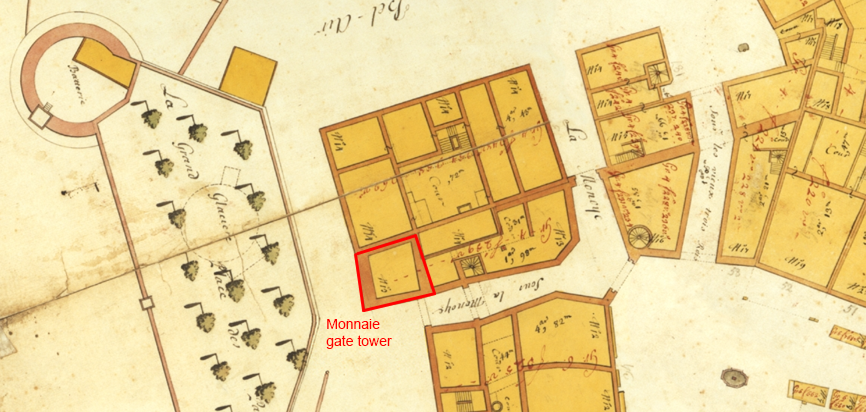
The Monnaie gate tower highlighted on Billon’s Plan from 1726.
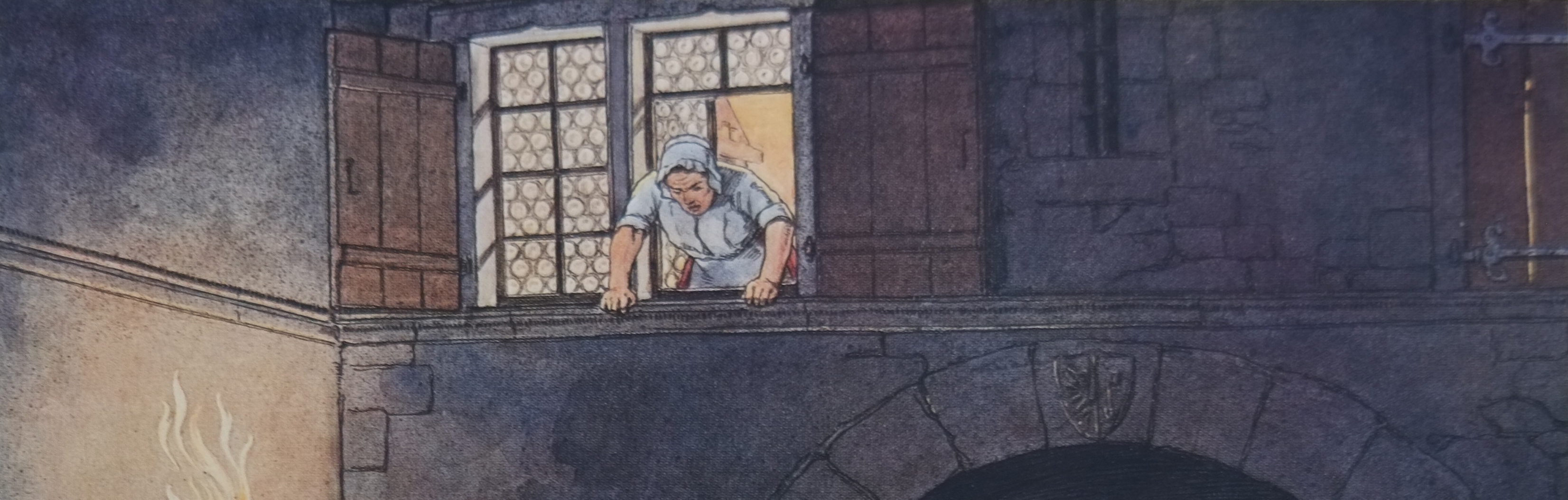
On the night of the Escalade, a number of Savoyards arrived at this gate, so it’s not hard to see why Madame Royaume would have had the opportunity to throw a pot from the window. However, the idea that she was simmering soup at 3 or 4 in the morning is implausible. More likely, Mother Royaume was awakened by the nearby fighting, and grabbed whatever she had lying around in an attempt to defend her home.
In Le citadin de Genève ou Response au cavalier de Savoye, written by Jean Sarasin in 1606, a woman is said to have thrown stones and the bottom of a barrel at the head of a Savoyard. It was probably only after 1676 that the image of the cooking pot began to spread in the collective imagination. Indeed, that year, Dame Royaume’s grandson left several pewter objects to his descendants, including a “pot dit de l’Escalade, […] d’estain gravé et de la façon de feu Pierre Royaume mon aïeul”. Of course, these elements are not entirely contradictory: we can imagine that Mother Royaume not only threw stones and the bottom of a barrel, but also the famous pot, and perhaps other things as well.
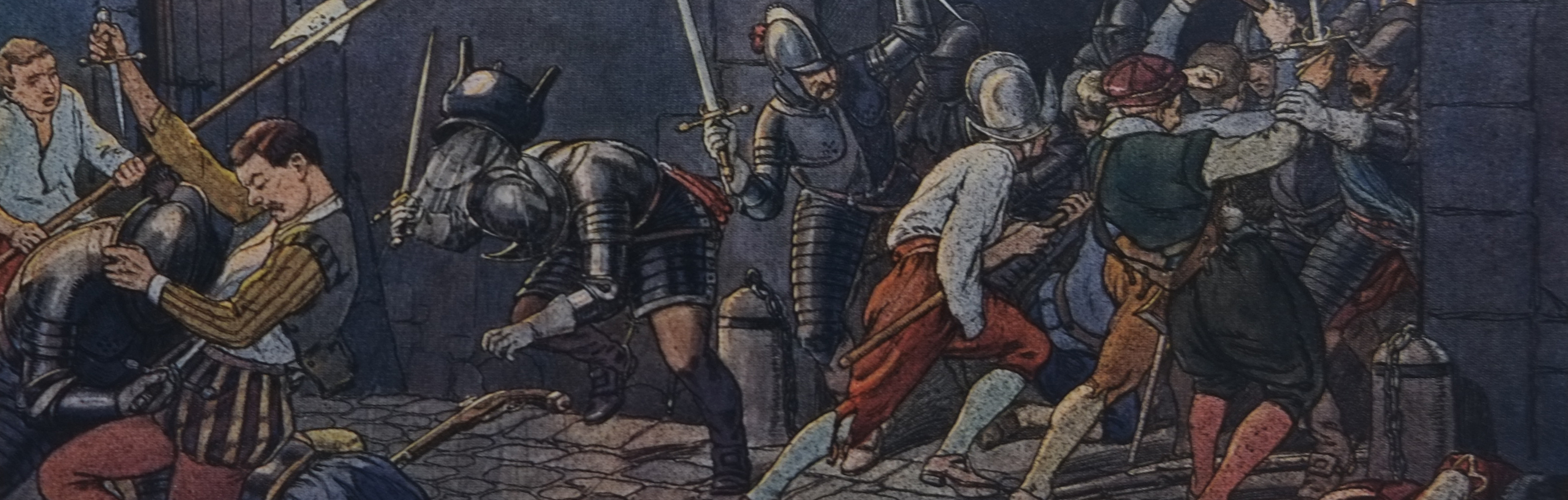
In the end, it doesn’t really matter whether Dame Royaume threw stones, the bottom of a barrel, a pot or anything else, and whether that pot was actually full of soup or not… What matters in this story is that tradition has made it possible to remember this highly decisive night for Geneva’s future through this act of bravery whose veracity – apart from a few details – is indisputable.
Other figures have marked this event, such as Jeanne Piaget, who threw the key to her alley to the Geneva defenders to enable them to repel the enemy, or Isaac Mercier, who had the presence of mind to pull down the Oie gatehouse portcullis, preventing the Savoyard “pétardier” from blowing the gate open. Yet today it is Catherine Cheynel Royaume who remains the symbol of the Escalade, even though she is not listed as one of those who received an award after the battle.
We don’t know exactly when she died, but by 1605 – the year of her husband’s death – she was already dead.